
Total Shoulder and Reverse Total Shoulder Replacements
Stemless Total Shoulder
Reverse Total Shoulder Arthroplasty is a type of Shoulder Joint Replacement surgery which addresses not only glenohumeral arthritis, but also shoulder instability. With a traditional Total Shoulder Replacement or arthroplasty, the arthritic surfaces of the glenohumeral joint are smoothed and a prosthetic cup is placed in the glenoid or shoulder socket and a prosthetic ball is inserted into the end of the humerus or arm bone to replace the “ball and socket” joint. This type of surgery is very successful at relieving arthritic pain in patients who have intact rotator cuff tendons and other soft tissue structures to support the new prosthetics and provide good range of motion.
Patients who have shoulder instability due to deficient rotator cuff tendons may benefit from a Reverse or Inverse Total Shoulder Arthroplasty. This surgery is designed specifically for the treatment of glenohumeral arthritis when it is associated with irreparable rotator cuff damage, complex fractures or to revise a failed conventional Total Shoulder Arthroplasty as a result of deficient rotator cuff tendons. Reverse Total Shoulder Arthroplasty reverses the placement of the prosthetics. Instead of the prosthetic cup being placed in the glenoid socket, it is placed at the end of the arm bone or humerus. And, instead of the prosthetic ball begin placed at the end of the arm bone, the ball is placed in the glenoid socket. By reversing the location of the prosthetics, the shoulder’s center of rotation is altered enabling the deltoid muscle to compensate for the deficient rotator cuff. As a result, the deltoid muscle becomes the primary elevator of the shoulder joint enabling patients to elevate their shoulder and often to raise their arm overhead.
IMPORTANT INFORMATION
Mako Robotic-Arm Assisted Technology for Total Shoulder Replacement
Now Introducing Mako Shoulder, the powerful and innovative integration of Mako, Tornier and Blueprint.
Dr. Michael Durkin, is the first surgeon in Illinois to perform a MAKO robotic- assisted Total Shoulder Replacement. He is among a select group of physicians in the United States using this advanced MAKO technology to perform Total Shoulder Replacements. Dr. Durkin uses CT-based 3D planning combined with real-time surgical guidance to create and execute highly personalized procedures tailored to each patient’s anatomy. This technology allows for a higher level of accuracy that can improve movement and durability over time. The precision of the MAKO robotic assistance for Total Shoulder Replacements helps protect surrounding tissue during surgery, which may reduce postoperative pain and support a quicker recovery, combining innovation with patient-centered outcomes.
Preoperative planning features
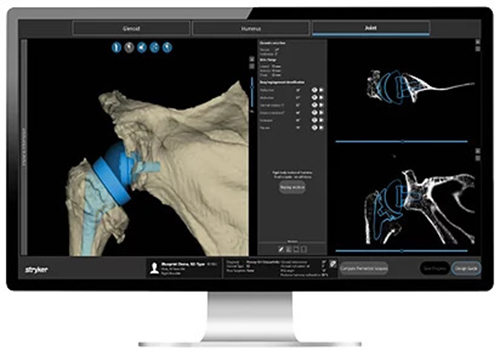
Blueprint 3D preoperative planning and Tornier Perform Reversed implants
Intraoperative features
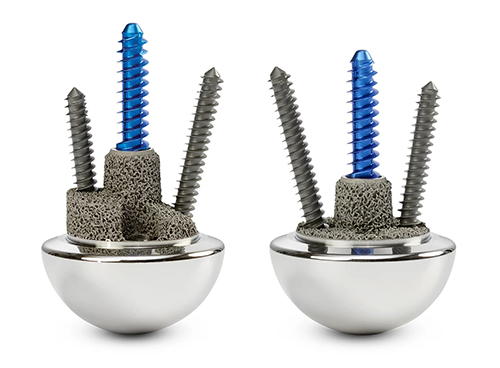
Haptically guided reverse shoulder glenoid implant preparation for primary joint replacement, including the glenoid surface, boss and post/screw
Accustop™ haptic technology
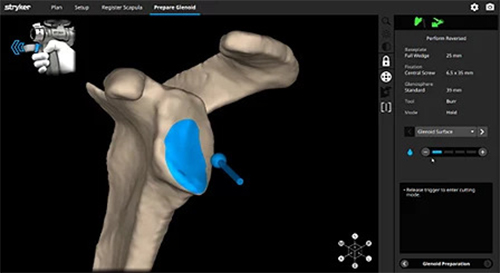
Leverages AccuStop haptic technology to create a virtual boundary that assists the surgeon in executing glenoid resection to plan
Learn more at www.stryker.com/us/en/joint-replacement/systems/mako-shoulder.html
References:
- Boileau P, Cheval D, Gauci, MD, Holzer N, Chaoui J, Walch G. Automated three-dimensional of glenoid version and inclination in arthritic shoulders. J Bone Joint Surg. 2018 Jan 3; 100(1) 57-65.
- Based on internal data as of 5/1/2025.
- Werner B, Hudek R, Burkhart K, Gohlke F. The influence of three-dimensional planning on decision-making in total shoulder arthroplasty. J Shoulder Elbow Arthroplasty. 2017 Feb 7; 28(8): 1477-1483.
- Aleem A, Orvets N, Patterson B, Chamberlain A, Keener J. Risk of perforation is high during corrective reaming of retroverted glenoids: A computer simulation study. Clin Orthop Relat Res. 2018 476: 1612-1619.
- Athwal G, Nelson, A, et al. Glenoid Preparation in Reverse Shoulder Arthroplasty: Robotic-Arm Assisted Preparation Compared to Manual Preparation and Patient-specific Guides. Journal of Shoulder and Elbow Surgery. 2024.
JR-MAKSH-SYK-2656232
Copyright © 2026 Stryker Corporation